
After a 27-year long alliance, the World Economic Forum (WEF) and the Confederation of Indian Industry (CII) have parted ways on organising the India Economic Summit, fuelling many theories on the reason. Both the organisations, however, sought to play down the development, saying it was a natural evolution for the Davos-based WEF to organise its event in India as it does in other regions.

The India Economic Summit which would deliberate on ways to enhance India's competitiveness and present the country's perspective to the business world, would begin in New Delhi from November 27-29
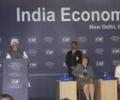
Maharashtra Chief Minister Prithviraj Chavan welcomed the joint decision of CII and WEF to hold the summit in Mumbai.
Finance minister P Chidambaram will inaugurate the 20th India Economic Summit to be held from December 5-7, 2004.
Chief Minister of Maharashtra Prithviraj Chavan said it is an opportunity for the state, which has been at the forefront of economic development in the country, to showcase itself as a favourable investment destination.
The WEF will be celebrating 25 years of its engagement with India at the annual economic summit.

Reminiscent of desi culture, a hotel staff was serving tea in normal glasses while standing next to a bicycle.

The summit would be held from November 4-6.
This and many more issues related to India's growth will be deliberated at the 22nd edition of the India Economic Summit, to be held here from November 26 to November 28
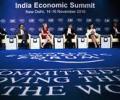
The current global financial crisis dominated the India Economic Summit's (IES) pre-event conference. The three-day event, being organised jointly by the World Economic Forum (WEF) and Confederation of Indian Industry (CII) from Saturday, would make its debut in this city after 26 years. The summit, an annual event, is usually held in New Delhi.

India is set to host the SCO Civilisational Dialogue Forum in New Delhi from November 20-22, with 15 countries, including China, Kazakhstan, and Iran, confirming participation. Union Culture Minister Gajendra Singh Shekhawat expressed hope for Pakistan's attendance, emphasizing the cultural commonalities despite geopolitical differences. The forum aims to reinforce cultural relations and showcase India's rich civilisational history.

The Ministry of External Affairs (MEA) has issued a warning against 'malicious' and 'misleading' social media posts concerning the health of world leaders, specifically Chinese President Xi Jinping and South African President Cyril Ramaphosa, who attended the recent BRICS Summit in New Delhi. The warning comes amidst unverified claims about Xi's health and an official statement from Ramaphosa's office confirming his withdrawal from public engagements due to ill health.

Notwithstanding the economic complementarities and the host of agreements for deepening economic relation on a host of areas, both sides share common viewpoints on the foreign policy domain and seek common grounds to serve as a counterweight to China, notes Dr Rajaram Panda.
South African President Cyril Ramaphosa on Friday described BRICS as an important global forum, highlighting the grouping's growing demographic and economic weight and noting that its members account for around half of the world's population and 40 percent of global GDP.

'India will become number one. There is no doubt about it. Andhra Pradesh will be number one in India.'

Engagement with neighbours has gathered pace, particularly as the conflict in West Asia has exposed their vulnerability to energy supply disruptions.
The 20th India Economic Summit to be held in New Delhi later this year will showcase India's advances and accomplishments in integrating with the global economy
BRICS leaders, in their New Delhi Declaration 2026, have called for wider access to Artificial Intelligence resources and stronger international cooperation to ensure the technology is safe, secure, inclusive, and reliable. The declaration outlines a broad technology agenda covering AI, cybersecurity, digital public infrastructure, telecom, quantum technologies, and advanced manufacturing, committing to implement the grouping's statement on 'Global Governance of Artificial Intelligence'.

During the 18th BRICS Summit in New Delhi, Chinese President Xi Jinping and Prime Minister Narendra Modi held a bilateral meeting, outlining a four-point approach for the steady and long-term development of China-India relations. The leaders stressed strategic understanding, win-win cooperation, mutual respect, and inclusive multilateral engagement, reaffirming their commitment to resolving the boundary question and addressing economic concerns. They also discussed global challenges and strengthening people-to-people ties.

US Treasury Secretary Scott Bessent's remarks come ahead of a high-level summit where India and the European Union are expected to formally announce the conclusion of negotiations on a comprehensive free trade agreement.

India and China are in what experts call 'a cooperation-versus-competition situation'.

Rajasthan Governor Haribhau Bagde highlighted ethanol's potential to protect India from volatile petroleum markets and geopolitical risks, advocating for its widespread production and use. He, along with other officials, emphasised ethanol's role in strengthening the rural economy, ensuring timely cane payments, and combating carbon emissions, while also discussing its historical context and current government support.

BRICS nations have successfully reached a consensus on a joint statement following extensive negotiations, with India playing a crucial role in bridging differences, particularly among West Asian members like Iran, Saudi Arabia, and the UAE, despite regional conflicts and geopolitical tensions.

'The Chinese military cannot advance much in Ladakh, even if they want to.' 'Similarly, in Arunachal Pradesh, they can rename a village or two, intrude here or there, but cannot do much more realistically.'

National Security Advisor Ajit Doval is in Beijing for the 25th round of Special Representatives talks on the India-China boundary issue with his Chinese counterpart Wang Yi. These crucial discussions precede Chinese President Xi Jinping's anticipated visit to India for the BRICS summit, offering a potential opportunity for a meeting with Prime Minister Narendra Modi. The talks aim to address the long-standing border dispute and recurring tensions, with both sides emphasising the importance of peace and tranquillity for bilateral relations amidst recent reports of aggressive Chinese posturing in Arunachal Pradesh.

Senior Congress leader Shashi Tharoor has articulated India's position on BRICS, advocating for it to be a "non-West, but not anti-West" platform, a stance he believes is crucial for India's national interest. He highlighted the prestige of hosting the BRICS summit, India's responsibility to represent the Global South, and the significance of bilateral meetings, particularly with China and Russia. Tharoor also addressed the strained India-China relations, citing border issues and trade leverage, and discussed the challenges within BRICS, including difficulties in achieving consensus on global issues and trade imbalances, while also considering the need for diversified international relations amidst unpredictable US sanctions.

Indian government sources revealed that a 'cautious approach' was adopted during Prime Minister Narendra Modi's June talks with then-US President Donald Trump due to concerns over Trump's 'unpredictable behaviour' with foreign leaders, leading to a preference against a joint media interaction.
National security advisor Ajit Doval arrived in Beijing on Monday for a two-day visit to take part in the Special Representatives talks on the India-China boundary question with his Chinese counterpart and Foreign Minister Wang Yi.

A senior US official has warned against the weaponisation of digital and artificial intelligence sovereignty by political voices, urging nations to avoid costly re-invention of existing technology. The official highlighted the economic dangers of rebuilding entire tech stacks and emphasised India's crucial role as an indispensable partner in global technological leadership due to its engineering talent and innovation ecosystem.
The 20th India Economic Summit, the annual event organised by the World Economic Forum and Confederation of Indian Industry, will see a large turnout of foreign investors and delegates this year.

European Commission President Ursula von der Leyen says India and the EU are close to a 'historic trade agreement' that could create a market of two billion people and account for almost a quarter of the global GDP.
The India Today group said on Monday it would launch an English language daily in New Delhi early next year.
India is ready to further cut import tariffs on industrial goods for using it as a strong bargaining point in World Trade Organisation negotiations, Commerce and Industry Minister Kamal Nath said on Monday.

Canadian Prime Minister Mark Carney on Tuesday warned that the world is witnessing a fundamental 'rupture' in the global order rather than a gradual transition, cautioning against weaponising trade, finance, and supply chains.

India and Canada are negotiating a long-term uranium supply agreement worth $2.8 billion. They are also exploring expanded civil nuclear cooperation after the passage of the SHANTI Bill.
